
Legacy Systems
The Real Risk of Running Your Business on Spreadsheets

Olga
August 21, 2026 · 7 min read
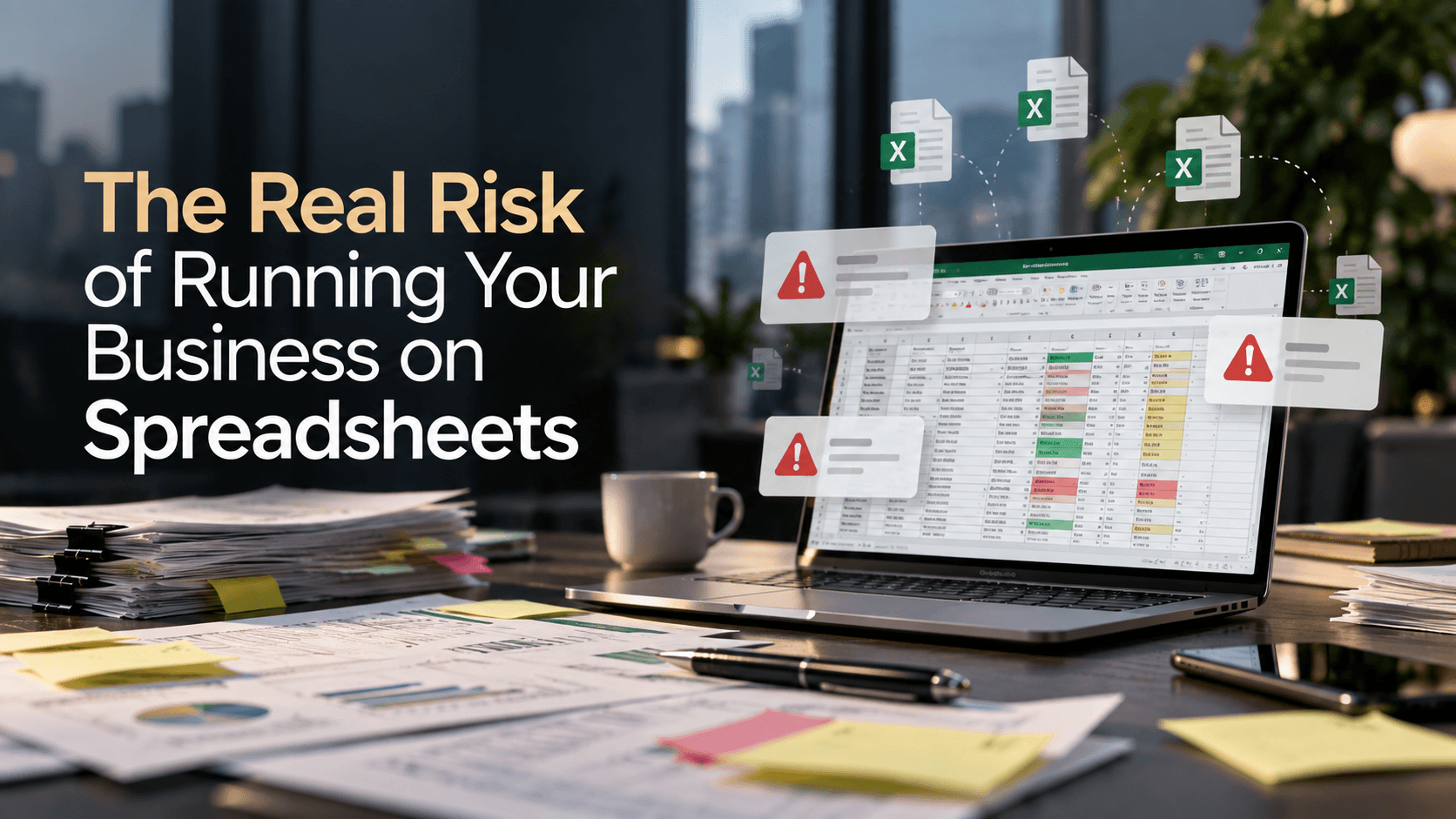
If your business runs on a spreadsheet someone built a few years ago — the one three people are now afraid to touch, the one with a tab called "DO NOT DELETE," the one that takes eleven seconds to open — you're not alone, and it's not really about the spreadsheet. It's about what happens when a tool built for a quick, one-off task quietly becomes the infrastructure your whole business runs on, and nobody ever went back to check whether it could actually handle that job. Two real stories show exactly how far that can go.
When it goes wrong at the biggest scale imaginable
In 2012, JPMorgan Chase lost $6.2 billion in what became known as the "London Whale" scandal. The root cause wasn't a market crash or fraud — it was a spreadsheet. A trader's risk model used Excel to calculate the bank's exposure on a massive credit portfolio, and a formula was set to divide by the sum of two numbers instead of their average, quietly understating the portfolio's real risk. Combined with copy-paste errors elsewhere in the same workbook, the model told the bank it was safer than it was, right up until it very much wasn't. The fallout included $920 million in regulatory fines and the bank's CEO having his pay cut in half that year.
When it goes wrong with actual lives at stake
In October 2020, Public Health England lost track of 15,841 positive COVID-19 test results. The cause: the case files were saved in the older .xls format, which has a hard limit of 65,536 rows. Once a file hit that ceiling, any new rows added past it were silently dropped — no error, no warning, just gone. Those missing cases never reached contact tracers in time, and as many as 50,000 people who'd been exposed were never called. Nobody set out to build a system that could quietly lose tens of thousands of records. Somebody built a spreadsheet to track test results, and it worked fine — until the volume of a real pandemic ran straight into a limit nobody had thought to check.
$6.2B
lost to one spreadsheet formula
JPMorgan's 2012 "London Whale" loss, traced to a risk model built and maintained in Excel.
15,841
COVID cases silently dropped
Public Health England, October 2020 — caused by Excel's old .xls 65,536-row ceiling.
50,000
people possibly never contact-traced
The downstream impact of records that simply fell off the bottom of the file.
The pattern behind both stories
Neither of these started as a crisis. They started as a reasonable, even smart, decision: someone needed to track something, a spreadsheet was the fastest way to do it, and it worked. The problem is that nobody ever came back to ask whether it should still be the way it's done once the volume, the number of people touching it, or the stakes had grown past what it was built for. That's the exact same pattern that shows up at small business scale, just with smaller numbers attached: the "temporary" tracker that's quietly become how the whole team invoices clients, or two SaaS tools stitched together with a Zapier chain that only one person — who may not still work there — actually understands.
Signs your spreadsheet (or duct-taped integration) has become a system
- More than one person edits it regularly, and you've had at least one "wait, who overwrote my changes?" moment.
- A real business decision — pricing, payroll, inventory, scheduling — gets made from it weekly, not occasionally.
- No single person could explain every formula, tab, or automation in it if you asked them today.
- It's slow, crashes, or has visibly hit a size limit — the exact shape of what happened at Public Health England.
- It was described as "temporary" or "just for now" more than a year ago.
- It connects to other tools through a chain of automations (Zapier, Make, custom scripts) that nobody has fully mapped.
What replacing it actually looks like
This is rarely a case for throwing everything out and starting over — it's usually a matter of giving the workflow that already works a proper backend: real validation instead of a formula that silently breaks, permissions instead of one shared file anyone can edit, and an actual database instead of a row limit you'll hit eventually. That's the shape of a Systems Integration engagement when the issue is a handful of tools glued together, or a Backend & Database Setup pass — real-time sync, proper structure, $2,000 over 2–4 weeks — when the issue is one file that outgrew its format. If it also needs a proper interface for the team to work in day to day, that's a Custom Dashboard, $3,200 over 3–5 weeks. None of it requires the drama of a $6.2 billion trading loss to justify — just the honest question of whether the tool your business runs on was ever actually built to.
Sources
- JPMorgan's London Whale: How an Excel Error Triggered a $6 Billion Loss — Pareto Investor
- Why You Should Never Use Microsoft Excel to Count Coronavirus Cases — The Conversation
- UK Hit by New Virus Test Failing, Finds 16,000 Extra Cases — PBS NewsHour
Related services

Is a spreadsheet secretly running your business?
Book a short call and we'll help you figure out what it would actually take to replace it properly.